
Undated
jewelry with a swan stamp
Swarovski swan with the company wordmark: a brand signature, not a precious-metal standard.
brand-logo drawing
Symbol guide
A stylised swan on crystal-set fashion jewelry is a Swarovski brand signature, introduced in 1989. A small swan in an oval on silver can instead be France’s cygne control mark for silver of foreign or unknown origin.
A stylised swan on crystal-set fashion jewelry is associated with Swarovski. Read its curved neck, compact body and accompanying wording as a brand device. It identifies a signature used by the company; it is not a silver or gold fineness mark. On jewelry, inspect the back of the setting, the clasp area and any attached signature tag. Keep separate metal inscriptions in the same photograph, since a logo and a fineness stamp answer different questions.
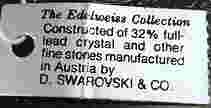
Swarovski introduced the swan logo in 1989 after earlier edelweiss branding. The first edelweiss logo appeared in 1899; a redesigned flower followed in 1980. In 2021 the brand introduced a new right-facing swan within an octagon. These dates describe the development of the brand logos. The older label illustrated here reads THE EDELWEISS COLLECTION and D. SWAROVSKI & CO.; it is a useful comparison, but it does not show a swan. The SC block emblem belongs to Swarovski’s Silver Crystal collectible line, so its chronology should not be treated as a date code for every jewelry stamp.
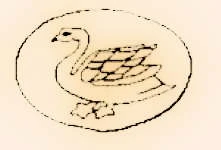
A small swan in an oval can be a French silver-control punch rather than Swarovski’s signature. The French cygne was introduced in 1893 for certain imported silver watch cases. Its later use includes silver of foreign or unknown origin and secondhand pieces without a readable original French guarantee mark. It is therefore a control mark applied to the metal, not the name of the jeweler. Compare the compact bird and oval surround with the flowing Swarovski logo and inspect the rest of the hallmark group.
Swarovski fashion jewelry uses plated metal parts; a gold-coloured or silver-coloured setting is not a purity designation. The word crystal also describes the ornamental glass rather than silver content. A French swan likewise does not identify a specific maker or provide an exact production year. For a silver item, read the separate maker’s punch and other national or fineness marks. A later control mark can occur on an older object, so its introduction date is not necessarily the date when the jewelry was made.
Logos can be copied, and a swan impression alone does not establish authenticity. Check its shape with the relevant logo version, the design of the jewelry, the quality of its construction and any accompanying maker wording. A heavily worn impression can lose the neck or wing detail. Keep the full mark and surrounding stamps visible instead of identifying an indistinct bird from its silhouette alone.
Undated
Swarovski swan with the company wordmark: a brand signature, not a precious-metal standard.
brand-logo drawing
Undated
French cygne: a swan within an oval, used as a silver-control mark rather than a jewelry-brand signature.
hallmark drawing
Undated
Comparison: The Edelweiss Collection / D. Swarovski & Co. label. This existing image shows earlier Swarovski wording, not a swan stamp.
The edelweiss mark preceded S.A.L.; the swan mark was introduced internationally in 1988.
Swarovski uses a stylised swan signature on its jewelry. A tiny oval swan punch on silver can belong to the French hallmarking system instead.
Swarovski dates the swan logo to 1989. The swan-in-octagon redesign dates to 2021.
The Swarovski logo does not state metal purity. The French swan is a silver-control mark, but it is not the same as a 925 sterling stamp.
The mark can identify the maker, but logos can be copied. Compare the correct logo design with the jewelry construction and accompanying wording.