
Undated
Flli Menegatti
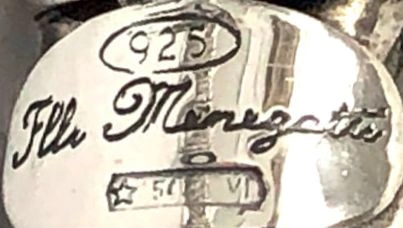
Italian comparison: Flli Menegatti with 925 and a separate star/54 VI identification punch; fineness and registered business are distinct.
Read the stamp
925 ITALY means sterling silver containing 92.5% pure silver, marked as Italian in origin. The number states the alloy’s silver content; ITALY states origin, while a separate name or star-and-number punch identifies the business.
The number 925 means 925 parts of pure silver in a thousand parts of alloy: 92.5% silver and 7.5% other metal. This is sterling silver. ITALY adds a country-of-origin statement; it does not raise the silver content above the sterling standard used elsewhere. The same number can appear as .925, 925 or 925/1000. A chain marked 925 ITALY and a sterling piece with another country name share the same stated silver grade. Maker names, trademarks and registration punches answer the separate question of who produced or supplied the piece.
An Italian identification punch can contain a five-pointed star followed by a registration number and province letters inside a polygonal outline. The number identifies the registered business; it is not the silver percentage or a date. The letters locate that business’s province. VI is the code for Vicenza, as in the illustrated Flli Menegatti comparison. The separate 925 punch states fineness. This company identification system can also apply to importers, so preserve every part of the punch when comparing a mark with the relevant chamber of commerce register.
Sterling silver can have a gold coating. A gold-coloured chain marked 925 therefore carries a silver-alloy designation underneath its surface finish; 925 is not a gold karat number. Vermeil describes gold-plated sterling silver. By contrast, silverplate is a silver coating on a base metal. GP, GF and HGE are gold-coating descriptions and need to be read in the complete inscription rather than substituted for a silver purity number. Surface colour alone cannot separate these constructions. A maker signature can occur alongside any material wording.
On a necklace or bracelet, examine the clasp, adjacent end tab and both sides of any small tag. A ring usually has room for the stamp inside the band; pendants can carry it on the back or bail. Keep fittings and the main piece separate when transcribing the marks, since a replacement clasp can carry different wording. Compare the illustrated Italian company punch with the Denmark and Norway examples below: all have 925, but the origin wording and maker devices differ. Counterfeit fineness punches exist, so the number should be read with the full maker and origin group rather than treated as an individual brand logo.
Undated
Italian comparison: Flli Menegatti with 925 and a separate star/54 VI identification punch; fineness and registered business are distinct.
Undated
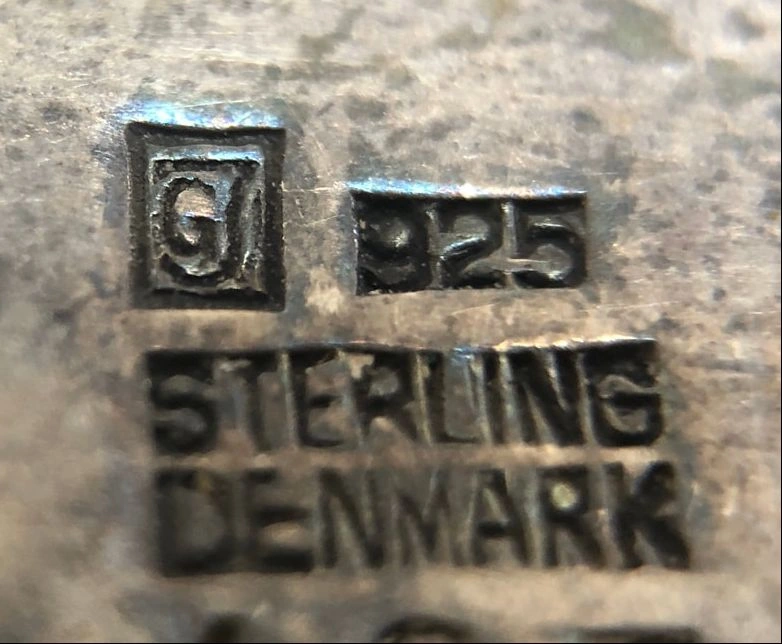
Country-wording comparison: GJ, 925, STERLING and DENMARK. The 925 grade is unchanged by the country name.
Undated
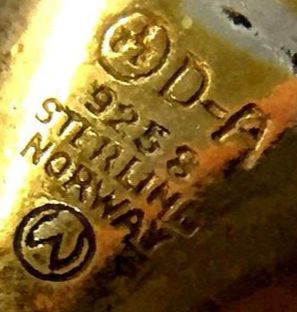
Country-wording comparison: David Andersen with 925 S, STERLING and NORWAY; this is a Norwegian example, not a 925 ITALY stamp.
It states sterling silver, 92.5% pure silver, and Italian origin. The maker is identified separately.
925 identifies a silver alloy. The gold colour can come from a coating on sterling silver; it does not make 925 a gold karat standard.
The Italian identification punch links a registration number and province letters to a registered business. It is separate from the 925 fineness mark.
Both state the same sterling silver content. Italy adds origin wording rather than a different purity.