Country guide
Danish pottery marks
Danish pottery marks can identify a factory, decorating business or individual designer. DENMARK, DANMARK, KJØBENHAVN and COPENHAGEN are geographical words shared by several businesses. Crowns also occur at more than one firm. The company emblem, initials and full wording are the useful starting points for a maker comparison.
Key makers’ marks
12 marks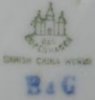
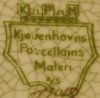
Kjøbenhavns Porcellains Maleri
After 1924
KPM Kjøbenhavns Porcellains Maleri A/S
porcelain · Copenhagen, Denmark
Kjobenhavns Porcellains Maleri A/S mark used
Kjøbenhavns Porcellains Maleri
From 1936
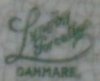
Lyngby Porcelæn DANMARK
porcelain · Lyngby, Denmark
Lyngby Porcellan mark used
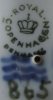
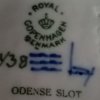
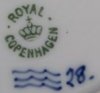
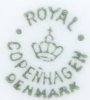
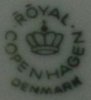
Royal Copenhagen
1962
COPENHAGEN
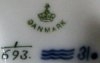
A bar below C in COPENHAGEN identifies the 1962 version.
porcelain · Denmark
Royal mark (a bar below C in ).
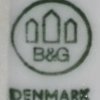
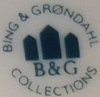

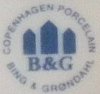
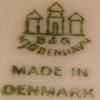
Bing & Grondahl
Undated
B&G / ENERET
This B&G Eneret version dates to the late nineteenth century.
impressed

About Danish pottery marks
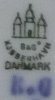
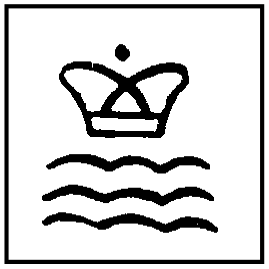
Royal Copenhagen was founded in 1775. Its three blue waves represent the Øresund, Great Belt and Little Belt, and occur with different crown and lettering formats. Bing & Grøndahl, founded in 1853, used a separate identity based on three towers and B&G. The companies joined in 1987, but B&G annual collector articles continued to use B&G wording. A late B&G plate therefore needs its own series context.
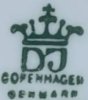
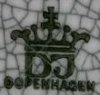
Other marks describe a decorating or later manufacturing business. Kjøbenhavns Porcellains Maleri began in 1883 as a porcelain decorating workshop using imported whiteware. Its later owners established the Danmark factory at Lyngby in 1936. A KPM shield on Danish-decorated porcelain is a different identity from Berlin’s royal manufactory. Dahl-Jensen’s crowned DJ is another Copenhagen mark.
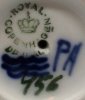
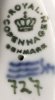
A base can also carry a shape number, decoration number and painter’s initials. These should be transcribed separately. Royal Copenhagen used changes in small dots and bars as date clues in particular periods; the position must be compared with the correct factory chart. A visible number beside the waves is not automatically a year, and two colours of the same stamp do not create separate maker identities.
How to read the marks
Start with the emblem: three waves, three towers, DJ or a named KPM shield.
Copy the complete company and place wording, including Danish spellings.
Record shape and decoration numbers separately from painter’s initials.
For Royal Copenhagen, photograph dots and bars closely enough to identify their exact position.
For B&G annual wares, keep the printed commemorative year and company stamp as separate readings.
Check whether a KPM shield names the Danish decorating workshop rather than Berlin.
Key makers
Royal Copenhagen / Den Kongelige Porcelænsfabrik
Copenhagen, Denmark; later international production · Founded 1775; continuing.
Porcelain tableware, figures, art pieces and collector plates.
Bing & Grøndahl
Copenhagen, Denmark · Founded 1853; joined Royal Copenhagen 1987; B&G identity continued on annual wares.
Porcelain services, figures and collector plates.
Kjøbenhavns Porcellains Maleri / associated Danmark factory
Copenhagen and Kongens Lyngby, Denmark · Decorating workshop founded 1883; Danmark porcelain factory 1936–1969.
Decorated imported porcelain, followed by Danish-made tableware under related identities.
Dahl-Jensen
Copenhagen, Denmark · Art-pottery business in the mid-1920s; porcelain marks from 1928.
Art pottery and porcelain figures.
Look-alikes & fakes
Three waves and three towers
Royal Copenhagen’s waves and Bing & Grøndahl’s towers are different company devices. Compare the complete emblem and wording, especially on later collector wares.
Danish KPM and KPM Berlin
A shield naming Kjøbenhavns Porcellains Maleri identifies the Danish decorating business. Berlin’s blue sceptre belongs to a separate manufactory.
Artist initials and factory signatures
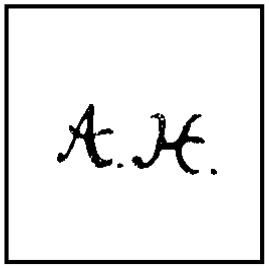
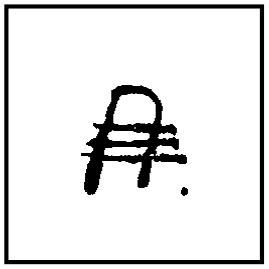
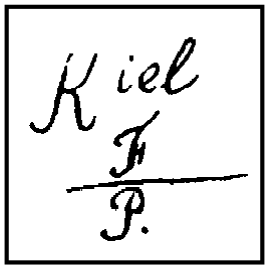
A handwritten letter group can identify a painter rather than the factory. Keep it with the waves, crown and named company stamp.
Copied marks and later branded production
Compare the exact logo, model and decoration together. Country wording and a familiar crown should be read with the specific series and production period.
Related marks
95 marks