
Country guide
Dresden marks on porcelain
Dresden porcelain marks belong to several factories and decorating studios in and around Dresden, Saxony. The name became associated with finely painted flowers, figures, elaborate gilding and historic European styles. Many Dresden businesses bought undecorated porcelain from other manufacturers, painted it in their own workshops and added a decorating mark. Carl Thieme’s factory at nearby Potschappel, established in 1872, also made porcelain bodies.
Key makers’ marks
12 marks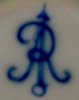
Lamm
1887–1915
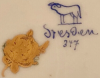
Dresden lamb and golden rose Ambrosius Lamm
porcelain · Dresden
The golden rose covered the original manufacturer mark.

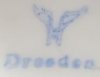
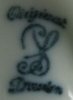
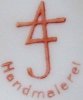
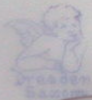
Lamm
Undated
porcelain
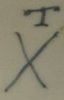
The putto mark was registered in 1910; registration alone does not establish its full period of use.
porcelain · Dresden, Saxony
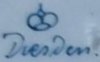
Donath
Undated
crown
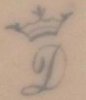
Crown Dresden mark registered in 1890; also used by Richard Klemm, Oswald Lorenz and Adolf Hamann.
porcelain · Dresden
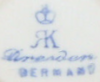
Klemm
Undated
RK
A version without GERMANY was registered in 1888.
porcelain · Dresden, Germany
Dresden Germany mark. Such mark but without a word Germany was registered in 1888

About Dresden porcelain marks
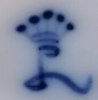
A crown above DRESDEN is therefore only a starting point. Initials, the form of the crown and surrounding words help separate studios. Richard Klemm used crowned RK formats; Ambrosius Lamm used a lamb, a play on his surname; Franziska Hirsch used H devices. Several businesses used similar crown-and-place marks, so the place name does not identify one workshop.
Two marks on the same base can describe different stages. An underglaze factory stamp may remain beside a decorator’s overglaze mark. Some Lamm examples have a gold rose covering the earlier factory stamp. This makes the blank’s shape and any surviving underglaze details useful companions to the decorating signature.
Meissen is a separate manufacturer. Its crossed swords and historical AR monogram were imitated by other businesses, including successors to Helena Wolfsohn’s studio. A blue AR or crossed device needs comparison with the complete mark and porcelain body; a Dresden address or Meissen-style decoration does not by itself make the piece Meissen.
How to read the marks
Photograph the base, the complete crown or monogram, and any separate factory impression.
Read the initials below or within the crown, then DRESDEN, SAXONY, GERMANY or HANDGEMALT.
Distinguish an underglaze body maker from an overglaze decorator. Look closely beside gilded patches or roses.
Compare the exact RK, H, lamb, SP or AR device; do not name a studio from DRESDEN alone.
Use specific stamp variants and object form together. A registration year does not necessarily mark the beginning of all similar designs.
Inspect applied flowers, lace and projecting parts alongside the base when comparing reproductions and later decoration.
Key makers
Carl Thieme / Sächsische Porzellan-Manufaktur
Potschappel, now Freital, near Dresden, Germany · Factory established 1872.
Porcelain figures, ornamental vessels, applied-flower wares and table pieces.
Ambrosius Lamm
Dresden, Saxony, Germany · 1887–1934; Clara Lamm and Rudolf Pitschke continued the studio afterwards.
Decorated porcelain with Dresden flowers, Watteau-style scenes and mythological subjects.
Helena Wolfsohn and successors
Dresden, Germany · Studio 1843–1945 through several owners; Wolfsohn-name successors from 1878.
Decorated porcelain on purchased blanks, including floral and historicist wares.
Richard Klemm
Dresden, Germany · Active in the late 19th and early 20th centuries; incorporated into Hutschenreuther’s Dresden operations in 1918.
Decorated porcelain, including gilded floral and figure wares.
Donath & Co.
Dresden, Germany · Late 19th and early 20th centuries; incorporated into Hutschenreuther’s Dresden operations in 1918.
Decorated porcelain with crown-and-Dresden marks.
Franziska Hirsch
Dresden, Germany · Late 19th and early 20th centuries.
Porcelain decorated under H and winged-H devices.
Look-alikes & fakes
Meissen crossed swords and AR
Dresden decorators used Meissen styles and some imitated its marks. Compare the full device and body rather than treating a blue monogram as Meissen.
Shared crown above Dresden
Several independent decorators used a crown with the city name. A generic crown needs additional initials or a matching complete format.
Dresden Porcelain Co., England
An English company used Dresden in its business name. Its D P Co L and ENGLAND marks belong to a different manufacturing group.
Later decoration or reproduction
An old porcelain blank can receive later painting or a copied stamp. Compare the factory and decorator marks separately with the model and decoration.
Related marks
55 marks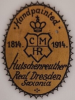
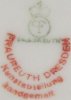
RWZRMark wording
c. 1898–1907
Clara Lamm & Rudolf Pitschke
Dresden, Germany
Used between 1887 and , registered relatively late at the under №·31·963 on -13.
A.RMark wording
c. 1881
X.E. Stephan Porzellanmalerei Helena Wolfsohn Nachfolger
Dresden, Germany
Used . Even if it is different, it still impersonates the " " mark.


Porzellanmalerei R. Grossbaum & SöhneMaker name
1892–1914
Porzellanmalerei R. Grossbaum & Söhne
Dresden, Germany
Used between , here on an otherwise unmarked item.
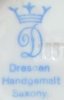
Undated
Donath
Crown Dresden mark registered in 1890; also used by Richard Klemm, Oswald Lorenz and Adolf Hamann.
porcelain · Dresden



Browse makers
14 makersHutschenreuther Hohenberg13 marksFraureuthGermany23 marksClara Lamm & Rudolf PitschkeGermany11 marksLamm8 marksX.E. Stephan Porzellanmalerei Helena Wolfsohn NachfolgerGermany6 marksErnst Göcke5 marksJunkersdorfGermany5 marksPorzellanmalerei R. Grossbaum & SöhneGermany5 marksFranziska Hirsch4 marksHelena WolfsohnUnited Kingdom4 marksKlemm3 marksDonath1 markKoch1 markLeube1 mark