
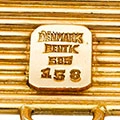
Undated
Bent Knudsen
BENT K / DENMARK /585: maker, origin wording and gold fineness in separate lines.
Read the stamp
Gold hallmarks identify the gold alloy’s fineness separately from its maker or sponsor and assay office. Common purity pairs include 14K/585 and 18K/750; letters such as GF or GP change the reading to a gold covering over another metal.
Read the whole inscription before selecting a maker. A karat number or three-digit fineness states the gold grade. A name, initials or emblem identifies the business responsible for the piece. Country wording such as ITALY is another clue and does not change the gold percentage. Several makers can use the same purity number. For a stamped group containing a designer name, 750 and a country, preserve all three: they answer different identification questions.
Karat divides the alloy into 24 parts, while millesimal fineness states gold parts per thousand. Eighteen parts out of 24 is exactly 75%, expressed as 750. Fourteen-karat gold is conventionally paired with585, the recognised 58.5% standard; the direct fraction 14/24 is about 58.33%. Keep the stated numerical standard when describing a stamp instead of silently replacing it with a rounded calculation. Yellow, rose and white gold can use the same purity grade.
| Stamp | Common gold grade |
|---|---|
| 375 | 9K / 37.5% |
| 417 | 10K / about 41.7% |
| 585 | 14K / 58.5% |
| 750 | 18K / 75% |
| 916 | 22K / 916.6 ppt standard, stamped 916 |
| 999 | Fine gold / 99.9% |
A complete UK hallmark combines a registered sponsor, the metal-and-fineness mark and an assay-office device. London uses a leopard’s head, Birmingham an anchor, Edinburgh a castle and Sheffield a rose. The office identifies where the article was assayed; the sponsor can be a manufacturer, retailer, wholesaler or importer. A date letter, when present, gives a separate hallmarking-year clue. A lone 750 inscription is therefore a different amount of information from a full British hallmark group.
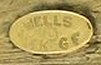
In 14K GF, the karat applies to a mechanically bonded gold-alloy covering, not the whole base-metal core. RGP means rolled gold plate. GP means gold plated, and HGE means heavy gold electroplate. Copy these letters and any fraction with the number. Removing the covering abbreviation changes the description of the object. The maker’s name beside such a stamp remains an identity clue rather than a promise that every product of the firm was made in gold throughout.
Check ring interiors, clasp fittings, chain end tags and pendant or brooch backs. Compare the main piece with any detachable or replacement component. Keep the outlines around small punches visible in photographs, since they help distinguish shared initials. Generic numbers and symbols can also appear on counterfeit objects. When the inscription and the object disagree, checking the complete mark group and the metal provides the next useful information.
Undated
BENT K / DENMARK /585: maker, origin wording and gold fineness in separate lines.
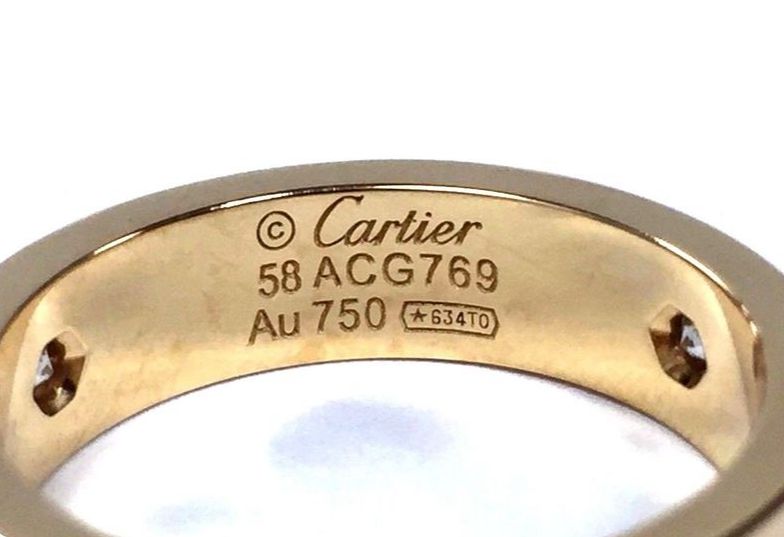
They can identify purity, the responsible maker or sponsor, the assay office and sometimes the hallmarking year. Read each part separately.
585 is 14K gold and750 is 18K. A 375 mark is 9K; a 916 mark is used for 22K. Keep any GF, GP, RGP or HGE suffix with its karat number.
No. ITALY supplies origin wording. A separate karat or fineness mark gives the gold grade.
No. GF describes a bonded gold-alloy covering over another metal; the 14K applies to that covering.