

Undated
William Rawlings Sobey
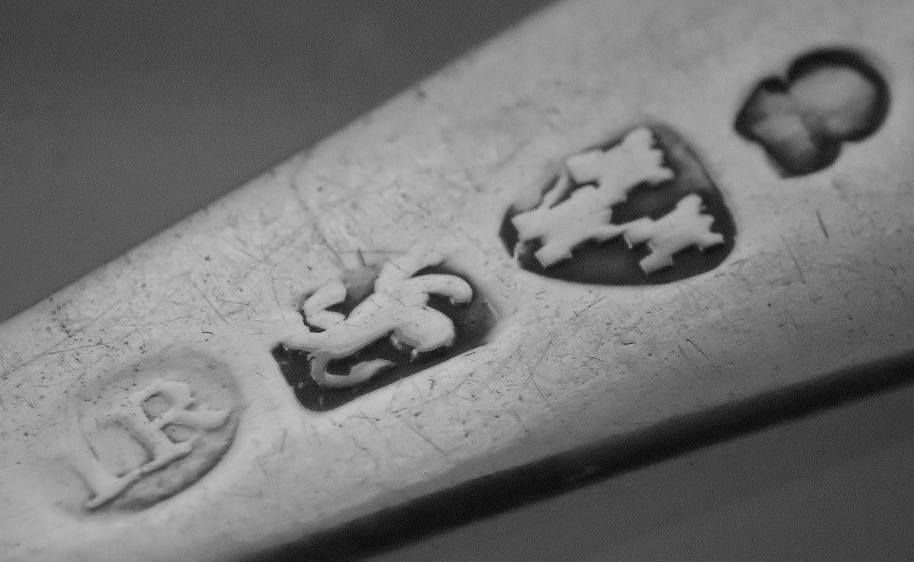
William Rawlings Sobey: WRS beside an Exeter castle, illustrating why town marks matter when initials are shared.
Illustrated hallmark dated 1840.
Read the stamp
Collectable rare silver marks include the devices of closed provincial assay offices, early Britannia-standard combinations and uncommon maker punches. Identify the town, standard, date letter and maker together: the particular combination gives the object its place and period.
Silver from a closed assay centre can interest collectors because it belongs to a particular local trade. Newcastle used three separate castles; Exeter used a castle with three towers, with a crowned X on earlier silver. Chester’s familiar town device is three wheatsheaves with a sword. The offices closed in 1884, 1883 and 1962 respectively. These are different places with different date-letter series. Exeter’s single castle must also be separated from Edinburgh’s castle: compare the whole hallmark group rather than assigning a town from a blurred tower.
A seated Britannia figure and a lion’s head with a jagged neckline belong to the higher silver standard introduced in 1697. Its historical fineness was 958.4 parts per thousand. It replaced sterling as the required standard until 1720, when sterling was admitted again. Britannia silver continued afterwards, so the figure alone does not date a piece to that early interval. On a later numerical hallmark the standard is shown as 958. Separate Britannia, the figure, from a maker’s initials or a town device.
Initials are not unique without their outline and lettering. William Rawlings Sobey and William Robert Smily both used WRS punches, but their registered forms and assay contexts differ. An Exeter castle helps separate Sobey’s work from Smily’s London examples. Keep stops, joined letters, superscript characters and the shape of the surround when comparing a punch. A retailer’s engraved name may appear elsewhere on an object; it does not replace the sponsor’s registered mark among the hallmarks.
Start with the town device before matching a date letter. Capitals, lower-case letters, typeface and shield shape distinguish repeated alphabets. Before the common January changeover introduced in 1975, offices often used letters across parts of two calendar years. Newcastle has additional early irregularities: before 1773, annual changes and alphabetical order were not consistently followed. A familiar-looking letter therefore needs its Newcastle context. The date identifies hallmarking, while the maker’s working period helps check the attribution.
A polished or partly struck common mark can lose small details and resemble an unfamiliar symbol. Compare its remaining outline with a complete example of the same office and period. Rarity is attached to a recognised maker, local origin, date or object type, rather than to how puzzling the stamp first appears. Condition, form, workmanship and the completeness of the object also matter when comparing sale results. A scarce provincial punch is one feature of the piece, not a price printed into its hallmark.
Undated
William Rawlings Sobey: WRS beside an Exeter castle, illustrating why town marks matter when initials are shared.
Illustrated hallmark dated 1840.
Undated
John Robertson I: the Newcastle group includes three separate castles beside the sterling lion.
Captioned hallmark: Newcastle c. 1795. Registration: c. 1795.

Undated
Dorothy Langlands: DL and a Newcastle hallmark group; compare the oval maker punch separately from the town device.
Illustrated Newcastle 1810 hallmark.
Collectors seek identifiable combinations such as early provincial silver, work from closed offices and uncommon maker punches. Newcastle’s three castles and Exeter’s castle are useful starting points for identification.
An uncommon maker or provincial origin can add collector interest. Value also depends on the object’s form, condition, craftsmanship and comparable sales.
No. Britannia standard began in 1697 and continued after sterling was allowed again in 1720; read the accompanying office, maker and date marks.