
Country guide
Made in Japan backstamps
Made in Japan is a country-of-origin statement, used by many ceramic factories and export businesses. It occurs on porcelain dinner services, stoneware, vases and figurines. A base may carry a Japanese manufacturer’s emblem, an American importer’s label, a pattern name and a stock number together. Each identifies a different part of the object’s commercial history.
Key makers’ marks
14 marks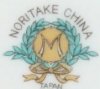
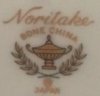
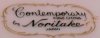
Noritake
From 1975
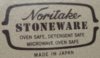
Noritake STONEWARE OVEN SAFE DETERGENT SAFE MICROWAVE OVEN SAFE MADE IN JAPAN
stoneware · Japan
Noritake Oven Safe, Detergent Safe, Microwave Oven Safe, Made in mark used .
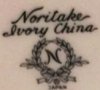
Noritake
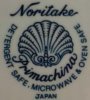
From 1988
Noritake Primachina DETERGENT SAFE MICROWAVE & OVEN SAFE JAPAN
porcelain · Japan
Noritake Primachina Detergent Safe Microwave & Oven Safe mark used .
Noritake
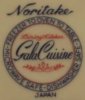
From 1989
Noritake Gala Cuisine JAPAN
porcelain · Japan
Noritake Gala Cuisine Freezer to Oven to Table Microwave Safe Dishwasher Safe mark used .
Noritake
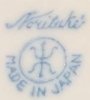
Undated
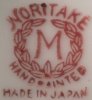
Noritake MADE IN JAPAN
Komaru-symbol mark registered in London in 1908; this is a registration date.
blue · porcelain · Japan
Noritake
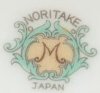
Undated
NORITAKE M JAPAN
The M Japan mark was registered in 1933; no use interval is stated.
porcelain · Japan
Noritake M mark registered in 1933.
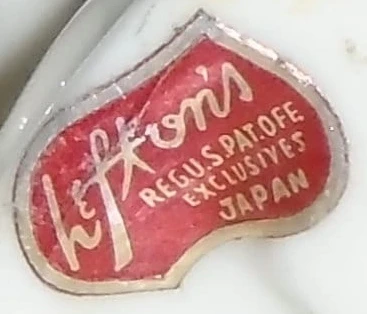
Lefton
Undated
Lefton’s / REG. U.S. PAT. OFF. / EXCLUSIVES / JAPAN
Red and gold applied label with registration wording and JAPAN; differs from Trade Mark/Taiwan label.
foil label · ceramic · Japan
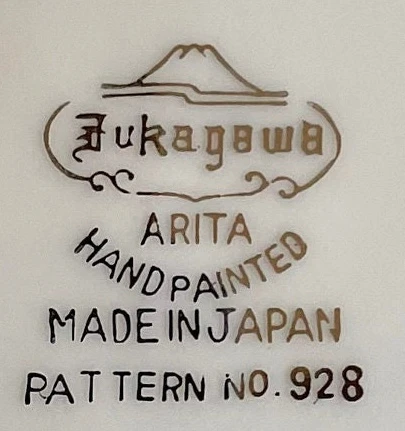
Fukagawa Seiji
Undated
Fukagawa / ARITA / HAND PAINTED / MADE IN JAPAN / PATTERN NO. 928
English name in decorative brackets above Arita and hand-painted wording. Other pattern numbers with this layout are not additional designs.
printed
About Made in Japan backstamps
The export trade expanded through factories around Nagoya and Arita. Noritake was established near Nagoya in 1904 and completed its first Western-style dinner service in 1914. Fukagawa Seiji, founded in Arita in 1894, made both artistic porcelain and tableware. Importers such as Lefton bought from Japanese suppliers and sold under their own brands, so an American company name can accompany Japanese origin wording.
NIPPON is another name for Japan and appears on earlier export china. JAPAN and MADE IN JAPAN continued across several decades, with separate occupation wording on some postwar pieces. From December 1949 the export directive allowed JAPAN, MADE IN JAPAN and MADE IN OCCUPIED JAPAN as alternatives. Plain JAPAN therefore cannot separate prewar from occupation or later production by itself.
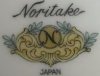
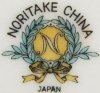
Read the company emblem independently of the origin line. Noritake’s M and N wreaths, its cartouches and later named ranges are different formats. Red and green printings of the same lettering and device remain the same design. Match country, emblem and full wording before comparing shape and decoration.
How to read the marks
Copy every origin word, including OCCUPIED when present; inspect any surviving foil or paper label.
Separate the manufacturer, importing company, pattern name and item number.
Compare the central device and wording, rather than treating every wreath or mountain as one maker.
Use NIPPON and JAPAN as broad export clues, then date the specific company stamp and form.
Check cups, saucers and other pieces separately; a service can contain replacements.
Keep labels dry when photographing them so the origin and importer wording survive.
Key makers
Noritake / Nippon Toki
Noritake, now Nagoya, Aichi, Japan · Founded 1904; first Western-style dinner service completed 1914; continuing.
Porcelain dinnerware and later bone china and stoneware ranges.
Fukagawa Seiji
Arita, Saga, Japan · Founded 1894; continuing.
Decorative porcelain, vases and tableware.
George Zoltan Lefton Company
Chicago, Illinois, United States; ceramics supplied from Japan and other countries · Founded 1941; later suppliers included Taiwan and Malaysia.
Imported figurines, tableware and ceramic giftware.
Look-alikes & fakes
European Japan patterns and Japanese-style decoration
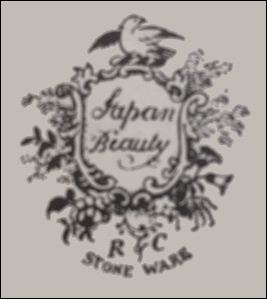
JAPAN can be a pattern name on English pottery. Read the maker and country line; a Japanese-style scene does not establish Japanese manufacture.
Occupied Japan
OCCUPIED supplies a more specific historical context, but plain JAPAN was also permitted from December 1949. The absence of OCCUPIED does not exclude that period.
Similar mountain emblems and replacement labels
Compare the full Fukagawa name and device. Other exporters used mountain-and-stream designs, and a loose importer label can be transferred between objects.
Noritake made outside Japan
Noritake also appears with SRI LANKA, PHILIPPINES or IRELAND. Read the origin line rather than assigning Japan from the brand alone.
Related marks
97 marks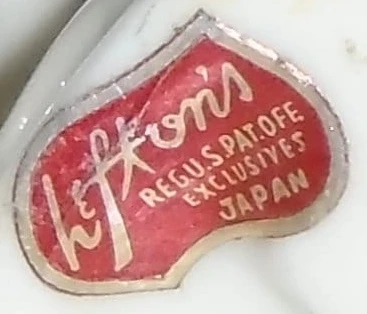
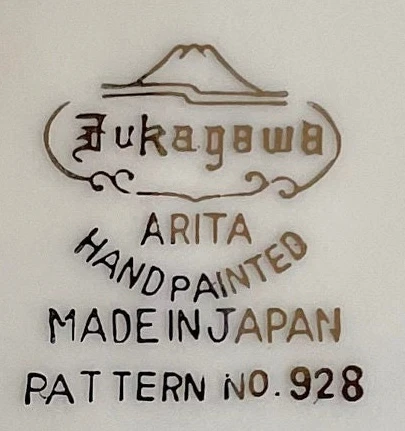
Undated
Fukagawa Seiji
English name in decorative brackets above Arita and hand-painted wording. Other pattern numbers with this layout are not additional designs.
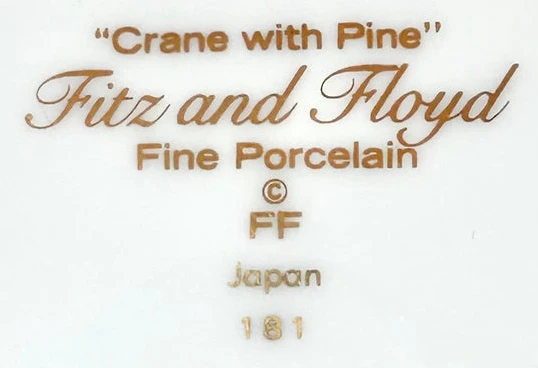
Undated
Fitz and Floyd
Script brand beneath a pattern name, with Fine Porcelain and Japan; 181 is not treated as a year.
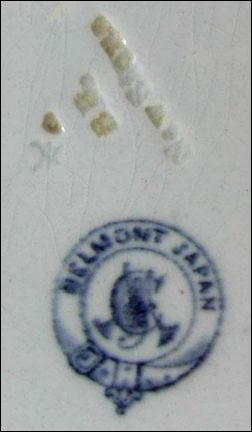
c. 1841–1873
Minton & Co
The Belmont Japan pattern was registered on 22 June 1860; the mark style is dated about 1841–1873.
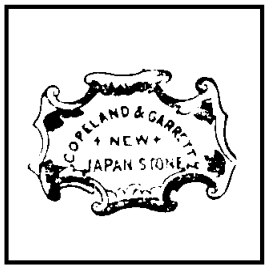
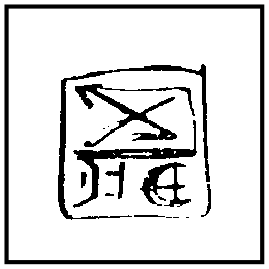
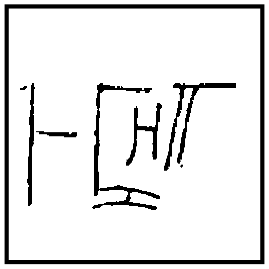
K.P.M.Mark wording
Undated
Arnart Creations / Arnart Imports
label · New York
Arnart " " mark, here with "Made in Japan" sticker.
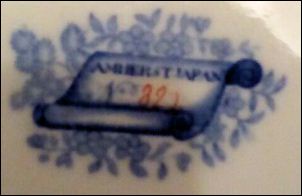
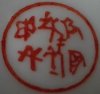
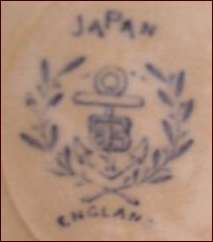
Wales ChinaMark wording
Undated
New York Merchandise Co., Inc.
New York
No date known: tableware mark with " " above the series name "Golden Wheat" and "Japan".
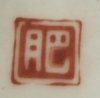
Charles Sadek Import Co. Inc.Maker name
Undated
Charles Sadek Import Co. Inc.
label · New Rochelle
Sticker with "Andrea by Sadek" on a Japanese Kutani item.
Geo. Zoltan Lefton Co. / Lefton-Pacific Inc.Maker name
Undated
Geo. Zoltan Lefton Co. / Lefton-Pacific Inc.
Chicago
No dates known, "American Beauty", Occupied Japan.
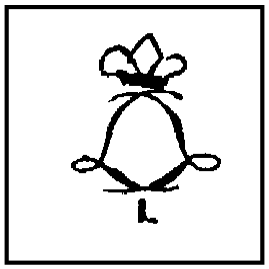
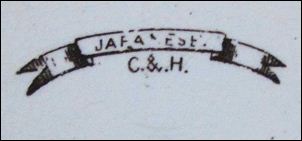
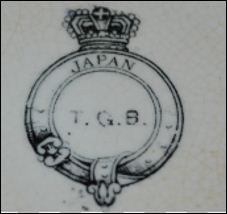
c. 1880–1885
Cumberlidge & Humphreys
This early style dates to about 1880–1885; marks without England are usually earlier than 1891.
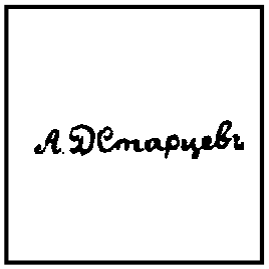
Undated
Startsev plant
porcelain · Putyatin Island, near Vladivostok
Characters were used on products intended for export to Japan.
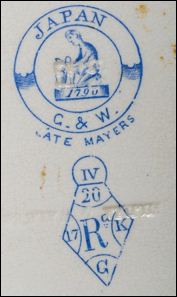
Undated
Gildea & Walker
The registration diamond dates the pattern’s registration to 20 February 1883.
Browse makers
24 makersLeftonUnited States5 marksDelftNetherlands236 marksFukagawaJapan5 marksFitz and Floyd5 marksNoritakeJapan32 marksMinton & CoUnited Kingdom12 marksStoke-on-TrentUnited Kingdom22 marksBowUnited Kingdom25 marksWorcesterUnited Kingdom120 marksArnart Creations / Arnart Imports50 marksCharles MeighUnited Kingdom26 marksParowa Tiefenfurt23 marksBritish Anchor Pottery Co LtdUnited Kingdom19 marksNew York Merchandise Co., Inc.16 marksJapanese11 marksCharles Sadek Import Co. Inc.10 marksGeo. Zoltan Lefton Co. / Lefton-Pacific Inc.9 marksClignancourtFrance5 marksCumberlidge & HumphreysUnited Kingdom5 marksThomas Gimbert BoothUnited Kingdom5 marksStartsev plantRussia4 marksGildea & WalkerUnited Kingdom3 marksRead & Clementson2 marksMoutreuil sous BoisFrance1 mark